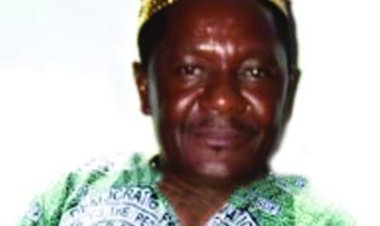



“Appointed Vice President Would Undermine Democratic Legitimacy in Cameroon”, Etonde Etonde, President of the Dreamers Party and former presidential candidate
 Sandrine Mballa



Etonde Etonde, President of the Dreamers Party and former presidential candidate, has voiced strong concerns over the ongoing constitutional reform debate in Cameroon, warning that the proposed creation of an appointed vice-presidential position could weaken democratic principles.
In a detailed statement, Etonde criticized the possibility that the vice president could be selected directly by the Head of State rather than elected by citizens. He argued that such a move would erode the fundamental principle of democratic legitimacy, which, in most modern presidential systems, is derived from universal suffrage.
According to him, introducing a vice president through appointment would sever the essential link between the electorate and executive power. “This represents a significant step backward,” he suggested, noting that democratic systems typically ensure that both the president and vice president are elected together, reinforcing accountability to the people.
Etonde also placed the debate within Cameroon’s historical context, recalling that the position of vice president existed during the federal era under Ahmadou Ahidjo before being abolished in 1972 with the transition to a unitary state. He stressed that any reintroduction of the role should aim at strengthening democratic institutions rather than serving short-term political interests.
The Dreamers Party leader further warned of potential risks to political stability, particularly regarding presidential succession. He argued that allowing unilateral influence over such a critical mechanism could lead to what he described as an “artificial continuity of power,” undermining the sovereign will of the people.
Calling for a more inclusive approach, Etonde insisted that any constitutional reform affecting the balance of executive power must be the outcome of transparent and responsible national dialogue. He lamented what he described as a lack of such engagement in the current process.
Beyond the specific reform proposal, Etonde highlighted broader concerns about the state of Cameroon’s political class. He pointed to what he sees as a decline in both material and intellectual capacity among some political actors, as well as the growing influence of ethnic considerations and social media dynamics in shaping political prominence.
For Etonde, the issue ultimately reflects a deeper governance challenge. He argued that attempts to secure power through indirect institutional mechanisms reveal an inability to present compelling political visions capable of winning public support.
“Cameroon deserves governance based on competence, accountability, and popular legitimacy,” he emphasized, calling for stronger transparency mechanisms, balanced institutions, and genuine citizen participation.
He concluded by reaffirming that any constitutional evolution must serve the national interest, preserve institutional credibility, and guarantee the full exercise of sovereignty by the Cameroonian people, warning that democracy cannot be sustained through what he described as “political shortcuts.”